01 · Product reference
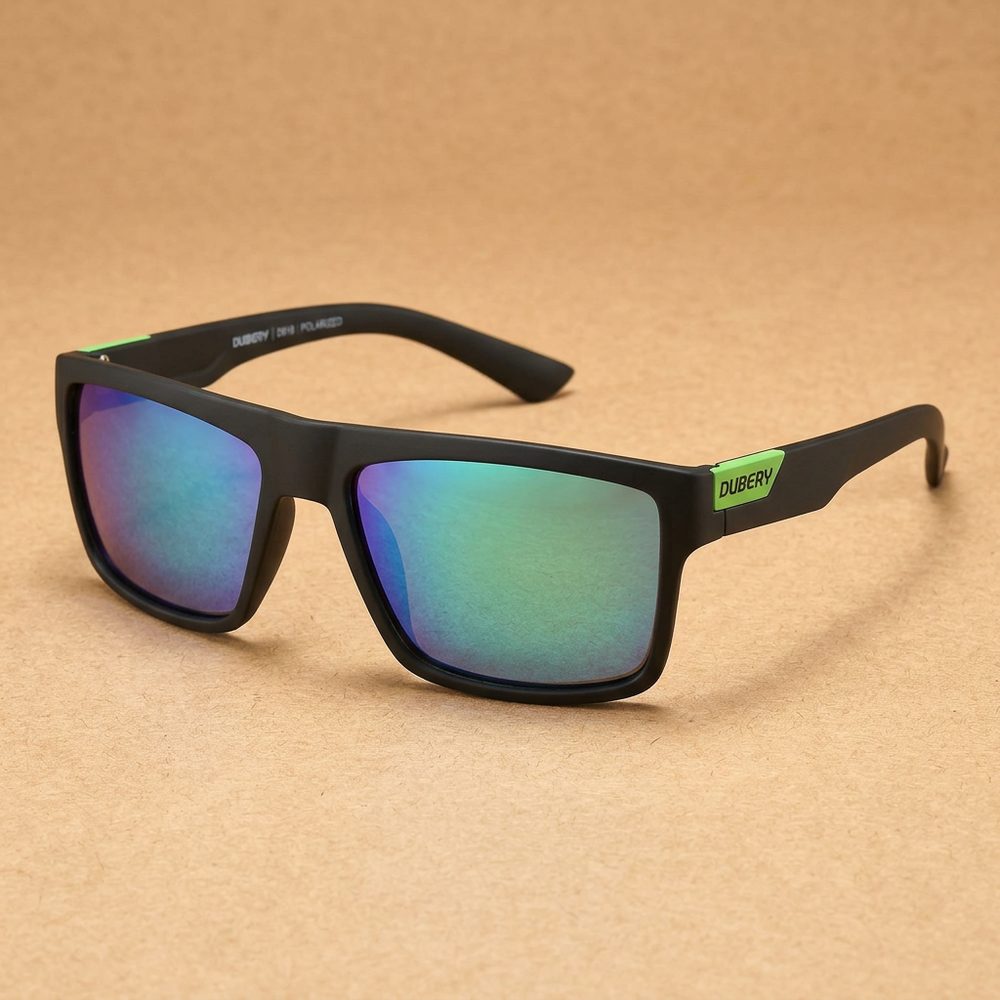
The product is a locked asset. The scene is the variable.
DuberyMNL is my own sunglasses brand. A sunglasses ad fails the moment the frame shape, the arm print or the logo drifts — customers notice. This is one real chain from start to finish, every step on file.
STEP 1
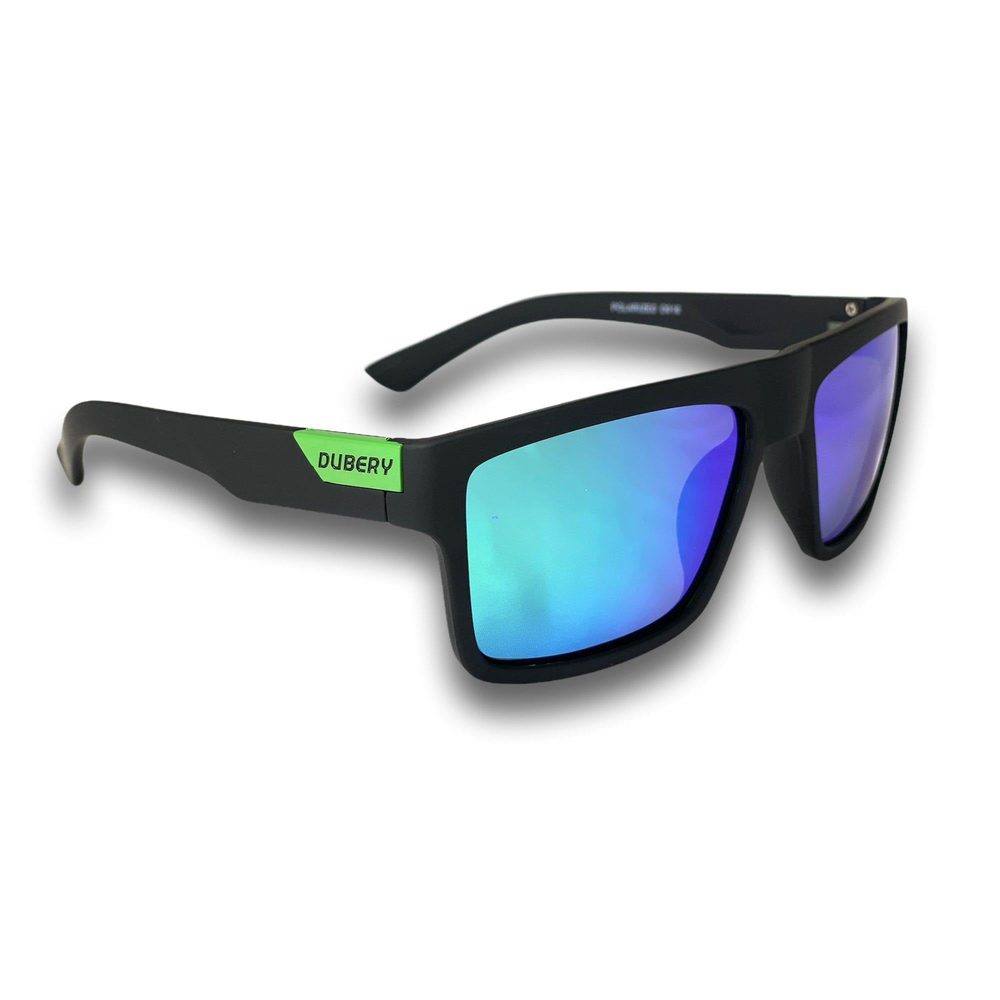
Supplier photo
The real product, white background.
STEP 2
Studio reference
Generated from it, plus a small file listing which details this angle actually shows.
Generate an image based on the following JSON parameters and the attached reference image - ensure that product attached keeps its identity and design do not hallucinate. The final image must look like a real DSLR/mirrorless studio PHOTOGRAPH, not a 3D render or CGI. Both models in the scene wear the SAME pair shown in the reference image -- two identical pairs:
{
"product_fidelity": {
"identity": "Dubery D918 Vintage Polarized Sunglasses (Outback Green) -- two identical pairs, one worn by each model",
"required_details": [
"Square-style matte polycarbonate frame with angular flat-top edge",
"Vibrant mirrored polarized lenses with a bright green mirror tint",
"Match product proportions, frame shape, temple pattern, emblem placement, lens color, and branding 100% against the attached reference photo -- no drift"
],
"proportions": "Standard retro frame with standard hinge-to-hinge width",
"state": "Two identical pairs of Dubery D918 Outback Green sunglasses. The MALE model is positioned CLOSE TO CAMERA -- his pair fills a significant portion of the frame and reads large with crystal-clear product detail (frame, branding, lens). The FEMALE model is positioned further back on the loveseat, her pair smaller in the frame but still clearly recognizable. Both pairs oriented to match the reference photo orientation (product angled slightly toward the left side of the frame from the wearer's perspective), so the RIGHT temple arm and branding badge read clearly to camera. Green mirrored polarized lenses behave as real photographed mirror glass with soft rectangular softbox catchlights and natural tonal variation -- not CGI, not uniform."
},
"interaction_physics": {
"blending_mode": "PHOTOREALISTIC_INTEGRATION",
"reflection_logic": "Treat the mirrored polarized lenses on BOTH pairs as REAL photographed glass mirror surfaces. Dominant highlight on each lens is the soft rectangular softbox key light IN FRONT of the models (soft rolled edges, faint flare). Soft tonal gradient across the lens, slight chromatic variation, realistic micro-imperfections at edges. Do NOT render uniform glossy plastic. Do NOT render a perfect mirror reflection of the background pixel set. Do NOT preserve reflections from the original product photo.",
"relight_instruction": "Use the product in INPUT_IMAGE_0 but digitally relight it to match the new location for each of the two pairs. The product must look physically photographed in the new scene with real specular highlights and real shadow gradients on the matte frame -- not pasted on, not CGI-rendered."
},
STEP 3
Locked prompt
Product facts pasted from one spec file. Highlighted lines never change.
STEP 4
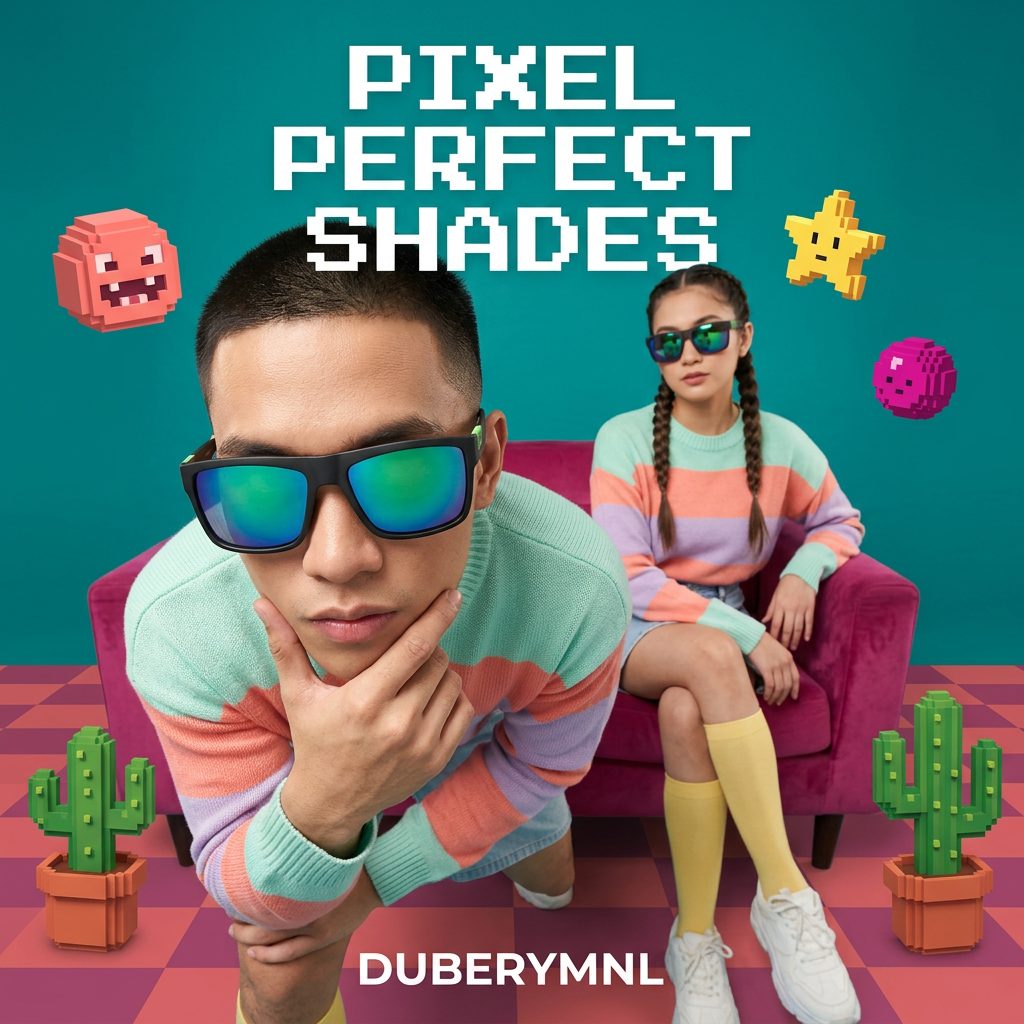
Final image
Two models, one pixel-art set — the same pair on both faces.
STEP 5
Into motion
The finished still, animated with Veo 3.1 image-to-video.
Read the full prompt behind step 4 1,231 words · locked lines highlighted
highlighted = pasted from the spec file or a fixed rule, identical across every prompt for this product
Generate an image based on the following JSON parameters and the attached reference image - ensure that product attached keeps its identity and design do not hallucinate. The final image must look like a real DSLR/mirrorless studio PHOTOGRAPH, not a 3D render or CGI. Both models in the scene wear the SAME pair shown in the reference image -- two identical pairs:

{
  "product_fidelity": {
    "identity": "Dubery D918 Vintage Polarized Sunglasses (Outback Green) -- two identical pairs, one worn by each model",
    "required_details": [
      "Square-style matte polycarbonate frame with angular flat-top edge",
      "Vibrant mirrored polarized lenses with a bright green mirror tint",
      "Match product proportions, frame shape, temple pattern, emblem placement, lens color, and branding 100% against the attached reference photo -- no drift"
    ],
    "proportions": "Standard retro frame with standard hinge-to-hinge width",
    "state": "Two identical pairs of Dubery D918 Outback Green sunglasses. The MALE model is positioned CLOSE TO CAMERA -- his pair fills a significant portion of the frame and reads large with crystal-clear product detail (frame, branding, lens). The FEMALE model is positioned further back on the loveseat, her pair smaller in the frame but still clearly recognizable. Both pairs oriented to match the reference photo orientation (product angled slightly toward the left side of the frame from the wearer's perspective), so the RIGHT temple arm and branding badge read clearly to camera. Green mirrored polarized lenses behave as real photographed mirror glass with soft rectangular softbox catchlights and natural tonal variation -- not CGI, not uniform."
  },

  "interaction_physics": {
    "blending_mode": "PHOTOREALISTIC_INTEGRATION",
    "reflection_logic": "Treat the mirrored polarized lenses on BOTH pairs as REAL photographed glass mirror surfaces. Dominant highlight on each lens is the soft rectangular softbox key light IN FRONT of the models (soft rolled edges, faint flare). Soft tonal gradient across the lens, slight chromatic variation, realistic micro-imperfections at edges. Do NOT render uniform glossy plastic. Do NOT render a perfect mirror reflection of the background pixel set. Do NOT preserve reflections from the original product photo.",
    "relight_instruction": "Use the product in INPUT_IMAGE_0 but digitally relight it to match the new location for each of the two pairs. The product must look physically photographed in the new scene with real specular highlights and real shadow gradients on the matte frame -- not pasted on, not CGI-rendered."
  },

  "scene_variables": {
    "location": "Studio set styled as a retro 8-bit / pixel-art world. Saturated peacock-teal cyclorama backdrop, warm coral-magenta and dusty-pink pixelated checkerboard floor running in perspective into the backdrop. Set dressing: two voxel-style pixelated cacti in warm terracotta pixel pots in the foreground corners; three or four floating low-poly pixel-art creature blobs in the air around and above the models (coral-pink monster face, yellow voxel star, magenta pixel ball) -- each rendered as cubic voxel objects with visible large pixels and stepped edges, soft contact shadows.",
    "subject": {
      "description": "Same TWO young adult Filipino models from the prior duo shoot. MALE: mid-20s, warm brown skin, sharp defined jawline, strong brows, deep-set eyes, high cheekbones, clean shave, short modern low-fade with slightly longer textured top. Pastel-striped knit sweater (soft mint, coral, lavender stripes) over light denim shorts, slouchy bright yellow knee-high socks, white chunky low-top sneakers. FEMALE: mid-20s, warm brown skin, two long French braids resting in front of her shoulders, soft defined features, natural minimal makeup. Coordinating pastel-striped knit sweater in a different stripe arrangement over a light denim short-overall, yellow knee-high socks, white chunky sneakers. Both editorial-model quality faces. Natural skin texture, real photographic micro-imperfections -- photographic, not CGI-smoothed.",
      "action": "MALE is leaning forward AGGRESSIVELY toward the camera off the front edge of a wide magenta velvet loveseat -- his face and shoulders fill the LEFT HALF of the frame from forehead-top to upper-chest, large and close. His forearms rest on his knees, one hand loose, the other lightly cupping his chin/jaw in a casual relaxed gesture. He stares directly into the camera through his green mirrored lenses. His sunglasses dominate his portion of the frame, every detail of the matte frame, right-temple branding, and green mirror lens reading sharp and large. FEMALE remains seated upright on the loveseat in the BACKGROUND further from camera, body slightly turned toward male, one arm draped along the back of the loveseat behind where he was sitting, the other hand resting in her lap. She is positioned in the upper-right portion of the frame at roughly half the apparent size of male. She also looks directly into the camera through her green mirrored lenses with a calm cool expression. Both wear identical Dubery D918 Outback Green sunglasses.",
      "emotion": "MALE: magnetic, close-up confident, owning the camera. FEMALE: cool, calm, supportive presence in the background. No smiles, no stiffness. Real photo-shoot pair-shot energy."
    },
    "subject_placement": "1:1 SQUARE composition with depth -- MALE in the foreground left dominates the left half of the frame from forehead at upper-edge down to upper-chest at lower-edge, his sunglasses sitting roughly at the center-vertical of the frame and reading LARGE. FEMALE is positioned in the upper-right quadrant of the frame on the loveseat behind him, smaller in apparent size (roughly 40-50% of male's apparent face size) and slightly defocused from the depth-of-field. The wide magenta loveseat is visible behind/around them. One voxel cactus visible in the bottom-right corner on the checker floor, one floating pixel creature visible in the upper-left corner near the headline, another floating creature visible behind female's shoulder. Upper portion of the peacock-teal backdrop is clean negative space for headline overlay. Lower-narrow band reserved for logo lockup. Both sunglasses on both models read clearly with right-temple branding visible to camera, male's reading especially large and crisp.",
    "lighting_atmosphere": "Real studio beauty lighting setup -- one large rectangular softbox key light front-camera-left at 45deg, smaller soft fill front-camera-right, subtle rim light edge-defining both models' hair and shoulders from behind-right. The softbox key reflects in each mirrored lens of both pairs as a soft rectangular catchlight with rolled edges. Saturated set colors but realistic light wrap and exposure -- this is a real photograph, not a render.",
    "camera_settings": "Full-frame mirrorless equivalent with a 50mm lens, eye-level with male's face, shot close to him so he reads large in the frame, f/4 for moderately shallow depth of field that holds male and his sunglasses tack-sharp while letting female fall into a slightly softer focus to read the foreground/background depth. 1/250s, ISO 200. Real-camera microcontrast, real photographic grain.",
    "overlay_typography": "Render typographic overlay directly into the image: at the top of the frame across the upper portion, the headline 'PIXEL PERFECT SHADES' on three stacked lines -- 'PIXEL' on the first line, 'PERFECT' on the second line at larger scale, 'SHADES' on the third line at the largest scale -- chunky 8-bit pixelated white sans-serif display face with visible square pixel edges, all caps, perfectly centered horizontally. Exact spelling: P-I-X-E-L / P-E-R-F-E-C-T / S-H-A-D-E-S. Floating pixel creatures must NOT overlap or obscure any letter. At the bottom-center, the wordmark 'DUBERYMNL' in clean medium-weight white sans-serif, all caps, modest size, perfectly centered, sharp and on-pixel. No other text anywhere."
  },

  "render_quality": {
    "resolution": "high",
    "color_space": "true-to-life",
    "background_blur_strength": "subtle -- male and his sunglasses tack-sharp, female and background slightly softer to read depth",
    "photographic_realism": "This is a REAL studio photograph captured on a real camera. Lenses, skin, hair, and frame finish on BOTH models must all read as photographed material, not CGI/3D-rendered surfaces."
  },

  "image_input": ["contents/assets/prodref-kraft/outback-green/01-hero.png"],

  "api_parameters": {
    "aspect_ratio": "1:1"
  }
}
Selected from the images I kept for DuberyMNL ads and posts. Same product references throughout; only the scenes change.